Climate-Shield™ Rain Screen Wood Siding System Installation Guidelines
Step 1 - Install structural sheathing to the framed wall system. Plywood or Oriented Strand Board (OSB) may be used. The panel thickness should be rated for structural application and be a minimum of 7/16” thick. Refer to local code requirements, but ½”, 5/8” and ¾” are standard sizes, obviously the thicker the board … the stronger the wall, and the greater the holding strength of the screw. Install per manufacturer instructions and local building codes. Please allow an expansion gap of 1/16” in between panel ends and 1/8” between panel edges. Foam and gypsum boards are not structural panels.
Step 2 - Install the drainage plane material. There are two basic categories:
Building Paper - Also known as felt paper, tarpaper, roofing paper or roofing underlayment. Building paper is an asphalt-impregnated paper that comes in different weights. For example, 15-lb. paper is typically used for most roofing and wall applications. For most builders, felt paper is the drainage plane of choice for roofing, and many builders use it to provide a drainage plane for the walls as well. Building paper resists air and water getting into the home, but allows moisture to diffuse through it. Microscopic pores in the paper allow moisture through but are so small that bulk water can’t penetrate its surface.
House Wrap - House wraps are available in a wide variety of different styles, brands and types of materials. Some serve mainly as a vapor barrier that allows moisture to pass from inside the building envelope to the outside. Other more advanced designs also serve as an air barrier as well as a moisture barrier. Follow manufacturer’s instructions for installation. Pay careful attention to seams and sealing around doors, windows and other openings.
Your Architect or Builder will have knowledge of local performance for these products. Regardless of the product you select, install per the manufacturer instructions and local building codes. The details of preparing the window and door areas are worth particular attention.
Step 3 – All windows and doors should now be installed. Please follow the instructions from manufacturers. (Note: When installing the siding interface to the windows and doors, we recommend leaving an 1/8” spaced gap, this will help minimize any misalignment that could be caused by potential expansion of the wood siding material.
Step 4 - Please create the base line elevation on all walls where the bottom of the siding will be installed. This can be done with laser lines, or a snapped chalk line. We recommend that you complete this on all walls, so you know you have continuity. This step is critical to a successful siding installation and should be done with accuracy. Do this well, and everything will be perfectly aligned as you build.
Step 5 - Install the outside and interiors corners systems you have selected. The Climate Shield System offers both Aluminum Extrusions and Solid Wood components. You may also install corners crafted by your builder. Please install the Climate-Shield System with the screws provided. They are the proper length and are made from stainless steel, the finest choice for your building. Make sure to attain perfect alignment of the corners. They should be installed at 90 degrees to the elevation lines you created in Step 3. Check your alignment as you move along the length of the corner attachment. If you do this with accuracy every siding board you cut will be a simple 90 degree cut and your alignment will be precise. With the Climate-Shield Aluminum Corner System, install only the outside corner base component at this time. (The outside corner finish piece installs after all the wood siding is installed)
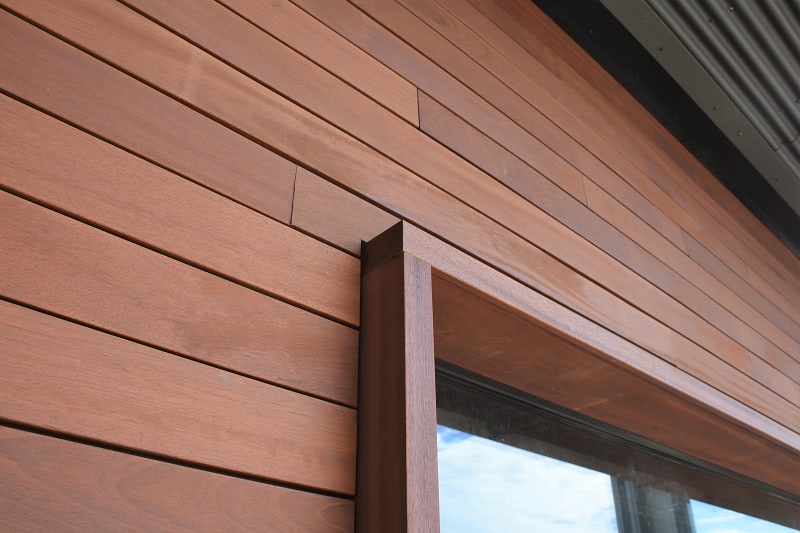
Step 6 – Install window and door trim. Climate-Shield offers Trim packages, or you can design your own. Now is the time to install them and put flashing in place. With Climate Shield components please use the screws supplied, as they have been designed for the application. Follow the window and door manufacturer's installation and flashing instructions.
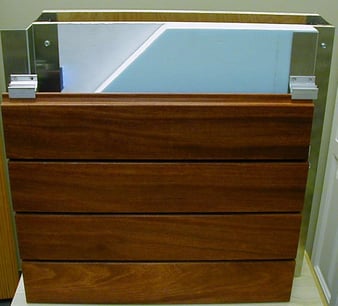
Step 7 – Installing starter course of siding. In this step you can choose to use Climate-Shield Rain Screen Clips or the Climate-Shield 8' Starter Rail. The Starter Rail speeds up installation and provides a continuous strip at your bottom course of siding. Detail drawings of these options can be viewed on http://www.mataverdedecking.com/architectural-specifications/
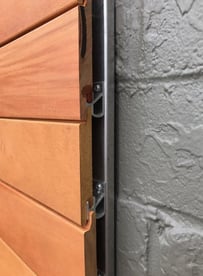
Method A.) If you are using the Climate-Shield Rain Screen Clips as a starter course, begin to install your starter row of Climate-Shield rain screen clips at the beginning elevation that you established in Step 4. Install a clip at the beginning of the wall base and then install every 16” to 24”, as your plans call for, screwing into your exterior sheathing. Finish the starter row with a clip at the end of the run to hold the end of the siding board. The clips are supplied with two stainless steel screws per clip. This system provides quick installation, with amazing strength. The screws feature a #3 Square Drive head for safe secure fastening (square drive head provided in screw package). Tighten all screws securely so the clips are flush to the sheathing.
Method B.) If you choose to use the Climate-Shield Starter Rail for your starter course of siding, the installation is very similar to Step 7. A. except that you simply follow the screw pattern on the rail to securely screw the starter rail flush to the exterior sheathing. This 8' rain screen starter rail will simplify and speed up your installation process.
Step 8 – We suggest installing a siding vent screen to prevent insects from entering the wall cavity from the ground. Follow the instructions of the manufacturer. The Cor-A-Vent SV5 siding ventilation is ¾”thick and fills the wall cavity between the drainage plane created by the Climate Shield rain screen clips. This siding vent also allows moisture and bulk water to escape as well. It is also suggested to install the siding vent at the soffit, above door openings and above and below window openings.
A.) If you are using 6" rain screen wood siding, align the Cor-A-Vent siding ventilation across the top of the starter row of rain screen clips (or rain screen starter rail) and fasten them to the sheathing. The assembly will be covered by the siding board in the next step.
B.) If you are using 4" rain screen wood siding, you will find it helpful to cut the Cor-A-Vent SV5 strips to length and fasten it between the rain screen clips in the starter row. If you are using the Climate-Shield Starter Rail with 4" rain screen siding, you will find it easier to install the Cor-A-Vent on top of the starter rail and cut it to length to fit between the rain screen clips at the top of the first course of siding. This assembly will be covered by the second course of siding.
Step 9 – Insert the bottom of a Climate Shield Rain Screen Wood Siding board into the previously attached rain screen clips or starter rail. The milling is quite precise to allow for climate variations in seasons and geographic locations. Occasionally you may need to use a rubber mallet to seat the board into the clip. Seating each board gives the perfect alignment that you want for your wall. Now begin attaching the clips to the top of the siding board. Same process, spacing at up to 24” and using 2 screws per clip. (Note: You can create a staggered arrangement with your clip spacing and on 24” installs you will have support to your board every 12”. This is a huge advantage over other installation systems.)
Step 10 – Repeat the assembly process for each row of siding. If you need to make a joint in the length of siding, simply use a rain screen clip at the bottom and top of the joint and straddle the two boards. You will automatically get proper alignment of the two boards. The joint can be done with 90 degree cuts, but over time the joints may open with weather exposure. We suggest that you miter the siding boards to be joined at a 45 degree angle (scarf joint), and there will be no gap showing in the future, regardless of the weather. Center the clip over the joint for maximum stability. This will give you a quality install that you will be proud of for years.
Step 11- Installing the top row of siding. When you reach the soffit (or areas below window openings), it is typically necessary to rip the top of the wood siding to the appropriate width. The bottom edge of the top row of siding will seat in the rain screen clip. The top edge of the siding will need to be drilled and face screwed to blocking behind the siding. We suggest short pieces of solid wood blocking behind where you will be screwing and placing siding vent between the blocking to allow continuous uninterrupted ventilation at the top of your rain screen wall system